



By Dr. Fadi Zaher, CIO
Over the past few weeks, I’ve spent time with our research, data and investment teams, and what stands out immediately is the depth of thinking across the firm. Osmosis has brought together experts across financial markets, the real economy and environmental science, all focused on a simple but increasingly important question: which companies are truly prepared for a world where resources are becoming more constrained and economically significant?
That question matters more each month. Energy systems are repricing. Heat and water stress are reshaping industrial economics. Supply chains remain fragile. Yet much of the market still appears anchored to assumptions built for a more stable and resource-abundant world.
There are five developments we believe are particularly important this month.
First, our proprietary investment signal is working, but markets are behind
The MoRE (Model of Resource Efficiency) framework measures companies on carbon, water and waste intensity relative to economic output, comparing them against their same sector peers. With data back to 2005, our recent research shows the Resource Efficiency signal is continuing to show widening dispersion between efficient and inefficient operators across sectors. In practical terms, companies with structurally lower energy, water and waste intensity are increasingly separating themselves operationally from peers, yet this divergence is not fully reflected in valuations.
We expect Q2 earnings to make this more visible to the broader market. Our research shows that Resource Efficient companies demonstrated more positive forward Earnings per Share (EPS) guidance revisions compared to their inefficient or neutral peers, a trend we have witnessed over the last two years in spite of market movements. Cost structures are beginning to move in ways that traditional financial models struggle to capture quickly, particularly where resource exposure sits deep within industrial and supply chains.
We are already positioned accordingly.
Second, energy costs have repriced sharply, while most equity valuations have barely moved.
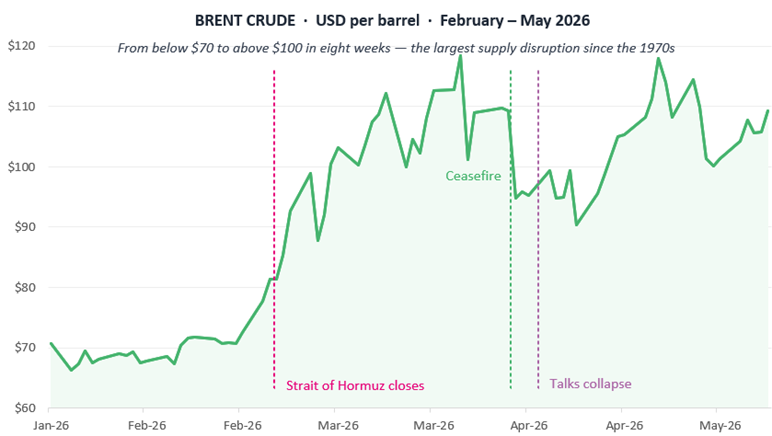
The World Bank’s energy price index surged more than 40% in March alone, one of the fastest monthly increases in recent decades. Brent crude moved from below $70 to above $100 per barrel in just a few weeks, the largest supply disruption since the 1970s.
Freight costs, fertiliser prices and a broad range of industrial inputs followed rapidly behind. Yet many analyst models still appear anchored to significantly lower input-cost assumptions.
What matters here is not simply the direction of commodity prices. It is the speed at which these costs move into company economics.
Businesses with high resource intensity can see margins compress surprisingly quickly when energy, transport and input costs rise simultaneously, especially where pricing power is delayed or constrained. In our view, markets are still underestimating this dynamic.
Third, heat is no longer a future climate scenario. It is becoming a present operating cost.
But energy prices are only half the story. Heat is the other half, and it is not yet priced in.
Research maps how rising ambient temperatures are affecting productivity, cooling demand, maintenance cycles and asset degradation across manufacturing, logistics and agriculture.
Importantly, these impacts are measurable now at the company level.
Facilities operating at higher temperatures experience lower labour productivity, increased cooling expenditure and accelerated equipment degradation. We increasingly view heat not as a distant environmental issue, but as a near-term margin issue hiding in plain sight.
Fourth, El Niño is returning, and the timing matters.
The National Oceanic and Atmospheric Administration (NOAA), a leading federal agency responsible for monitoring our changing climate, issued an El Niño Watch this week. NOAA assigned about 80% probability of emergence by July and over 90% probability of persistence through the winter of 2026–27.
Historically, major El Niño periods have amplified temperature anomalies, disrupted agricultural production and increased volatility across energy and commodity markets.
What makes this cycle particularly notable is that it arrives into an already constrained system: elevated energy costs, stretched supply chains and increasing heat stress across key industries. For portfolios already exposed to these pressures, this becomes a compounding, rather than isolated, risk.
The next two quarters may therefore prove more economically consequential than markets currently anticipate.
Finally, conviction is common. Precision is not.
What distinguishes this approach is precision, not conviction. Much of sustainable investing still relies on broad ESG classifications, incomplete disclosures or backward-looking assessments that can be difficult to compare consistently across companies.
At Osmosis, the approach remains fundamentally different. The objective of MoRE is to evaluate operational efficiency directly, rather than relying on narrative or disclosure quality alone.
Our forthcoming Implied RE Consumption research adds another analytical layer by deriving Resource Efficiency indicators directly from financial statements themselves. Where that gap between implied and reported figures is large, it tends to be informative for how we allocate capital.
We enter this quarter watching one thing above all: Q2 earnings guidance.
How much of the energy cost increase is visible in reported margin compression? How clearly does the gap between efficient and inefficient operators appear in actual results, rather than in expectations? That data will either confirm our signal’s direction with force, or prompt us to examine the pace of transmission more carefully. Either way, we will tell you exactly what we find.
Our commitment has never been to assert that the thesis is right. It has been to build a systematic, evidence-based investment process that continuously improves – so we can identify not only when it is working, but precisely why it is working.
On a personal level, what excites me most after joining Osmosis is the quality of the research and the clarity of the firm’s conviction with nearly two decades of climate and environmental investing. Long before resource constraints became a mainstream market discussion, Osmosis was building the data, frameworks and intellectual discipline to understand how physical efficiency ultimately shapes financial outcomes. I believe that work is becoming more relevant with each passing quarter, and I am honoured to help lead the firm through the next stage of its evolution.
Thank you for your continued trust and partnership.
Dr Fadi Zaher, CIO, Osmosis
Important Information
This document is issued by Osmosis Investment Management UK Limited (“Osmosis UK”). Osmosis UK is an affiliate of Osmosis Investment Management US LLC (“Osmosis US”), Osmosis Investment Management NL B.V. (“Osmosis NL”) and Osmosis Investment Management AUS Pty Ltd (“Osmosis AUS”), and has been operating the Osmosis Model of Resource Efficiency. Osmosis UK is regulated by the FCA (Reference number: 765056). Osmosis US is regulated by the SEC. Osmosis NL is licensed as a manager of AIFs and authorised to provide discretionary portfolio management services and as such is subject to supervision by the Netherlands Authority for the Financial Markets under registration number 15006165.Osmosis UK, Osmosis US, and Osmosis AUS are wholly owned subsidiaries of Osmosis (Holdings) Limited (“OHL”).
This research provided is for information purposes and does not constitute an offer or solicitation of an offer or any advice or recommendation to purchase any securities. No representations, express or implied, are made as to the accuracy or completeness of such statements, assumptions, estimates or projections or with respect to any other materials herein.
Our research identifies companies from the MSCI World or Emerging Market Index that report sufficiently on at least 2 of the following 3 metrics: carbon, water, and waste, to calculate a resource efficiency score for each reporting company – the Model of Resource Efficiency. Our Core strategies overweight efficient companies and underweight inefficient companies within each Osmosis defined sector, to remain sector neutral to each benchmark. Our Active strategies invest only in efficient companies, outside of the Financial sector described below. Companies in the Financials sector are not given Resource Efficiency Scores. Certain strategies select Financials, based on complementary characteristics to the Resource Efficiency factor, for inclusion in the portfolio to maintain the portfolio’s overall factor weightings. All strategies exclude tobacco and companies that breach the UN Global Compact on social and governance safeguarding.
The information contained in this document has been obtained by Osmosis from sources it believes to be reliable, but which have not been independently verified. Information contained in this document may comprise an internal analysis performed by Osmosis and be based on the subjective views of, and various assumptions made by, Osmosis at the date of this document. Osmosis does not warrant the relevance or correctness of the views expressed by it or its assumptions. Except in the case of fraudulent misrepresentation or as otherwise provided by applicable law, neither Osmosis nor any of its officers, employments or agents shall be liable to any person for any direct, indirect, or consequential loss arising from the use of this document.